Pegs, Pulleys and Passing Places: The Laundry Logic of a Lane House
There is a particular kind of optimism in hanging washing out on a lane. No lawn, no rotary drier, often no more than a metre of outside space between a kitchen window and a neighbour's wall — and yet the sheets still have to go somewhere. In a characterful old brick house, the question is rarely 'where is the garden?' It is 'where does the air go?' Get that right and the laundry follows. Get it wrong and you end up with fogged windows, damp plaster and a house that feels as if it has been holding its breath.
Start with the air, not the line
A single wash can release a surprising amount of water into a home. If that moisture has nowhere to go, it condenses on the coldest surfaces — often the glass, the north-facing wall, the back of a cupboard. Old brick houses are forgiving in many ways, but they are not immune to being sealed up and steamed. The trick is to treat drying as a ventilation problem first and a storage problem second.
That means cracking a window, using an extractor, or choosing a drying spot where moist air can leave rather than linger. It also means being honest about how much washing you are trying to dry at once. Two loads in a small back room on a wet Tuesday is not a drying strategy; it is a humidity experiment.
The passage as drying room, with rules
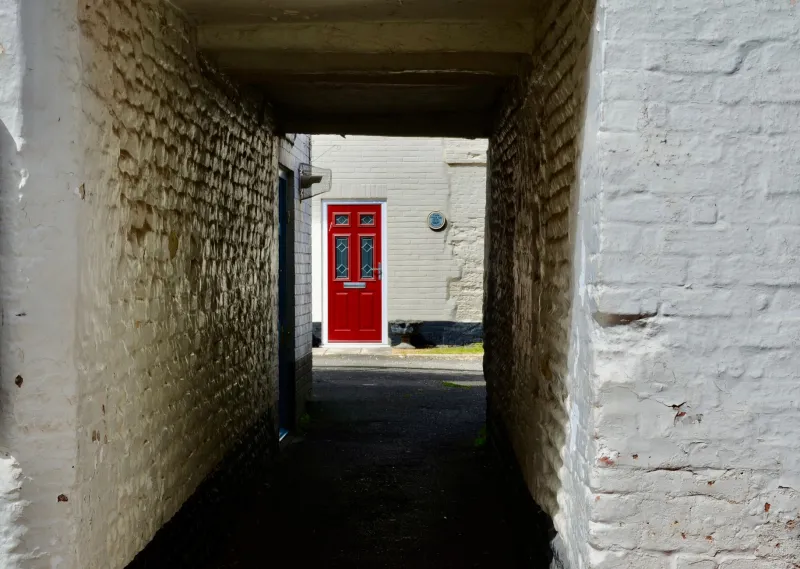
Many lane houses have a side passage — that narrow strip between the house and the boundary wall. It is often dark, occasionally draughty and frequently full of bins. It is also one of the best laundry spaces you have, provided you rig it with care.
A retractable line or a simple pulley system fixed from wall to wall can work beautifully. Use stainless fittings, and fix into mortar rather than hammering raw plugs into soft old brick. Keep the line high enough that people can still pass underneath, and make it removable so the passage does not become a permanent obstacle course. If the line crosses a right of way, even a informal one, keep it clear when not in use. Neighbours tolerate a lot; they are less keen on ducking under your tea towels.
A line in a passage will not get full sun, but it will get moving air. In a sheltered lane, that can be enough. Peg out shirts and sheets with space between them, not bunched like bunting. Air needs to pass through the fabric, not around it.
What the weather actually does in a lane
Lane houses often sit in a wind funnel. That can be a gift on a breezy day and a nuisance on a gusty one. A line that is too tight will snap pegs; a line that is too slack will sag into the wall. A small amount of give is useful. So is checking the forecast for rain rather than temperature alone. Cold, dry, breezy days dry washing perfectly well. Mild, damp, still days do not.
If you have a small courtyard or front area, a wall-mounted folding airer can be folded flat when not in use. It keeps the washing out of the passage and gives it a little more light. Just avoid covering air bricks or low vents. Those small openings are part of how the house breathes, and a damp towel draped over one is a quiet way of causing trouble.
Indoor options that do not wreck the brick
When outside is hopeless, indoor drying needs a plan. A heated airer in a closed room with a cracked window and a dehumidifier is a sensible combination. The dehumidifier pulls moisture from the air; the cracked window gives the room a chance to exchange stale air. A hygrometer — a simple humidity gauge — is a cheap way of knowing whether you are winning or simply making a warm fog.
Bathrooms with extractor fans can handle a small amount of washing, especially if the fan is left running for a while afterwards. Avoid draping wet clothes directly over radiators for hours on end. It feels efficient, but it pushes moisture into the room and can mark the walls. A ceiling-mounted pulley airer in a stairwell or bathroom is a traditional solution for a reason: it uses the warm air that already rises and keeps the floor clear.
The tumble dryer question
Not every lane house has room for a tumble dryer, and not every old house has the wiring or venting for one. A heat-pump condenser dryer is the least disruptive option if you can find a corner for it, but it still needs space, a level floor and somewhere for the water to go. If the only available spot is a cupboard off a passage, think about noise and heat as well as plumbing. A dryer that makes the whole house hum is not a neutral addition.
For some households, the answer is a good laundrette for bedding and a careful indoor routine for everything else. That is not a failure of lane-house living. It is simply matching the appliance to the architecture.
Small compromises that keep the house breathing
A fold-down airer on a passage wall, a retractable line under a canopy, a pulley above a stairwell, a dehumidifier on a timer — these are modest interventions. They do not require planning permission or a builder. They do require a little thought about where moisture goes and how people move through the space.
Keep the passage clear enough to walk through. Keep air bricks uncovered. Keep an eye on the paintwork near your drying spot; if it starts to bloom or flake, the moisture is telling you something. And accept that a lane house will never dry washing quite like a house with a garden. It will dry it in its own way, with a bit of draught, a bit of patience and a line strung between two walls.
That is not a compromise so much as a rhythm. Wash on the breezy days, peg out early, bring in before dusk, and let the house do what old brick houses do best: breathe.