Underfoot History: Repairing a Worn Staircase Without Erasing Its Age
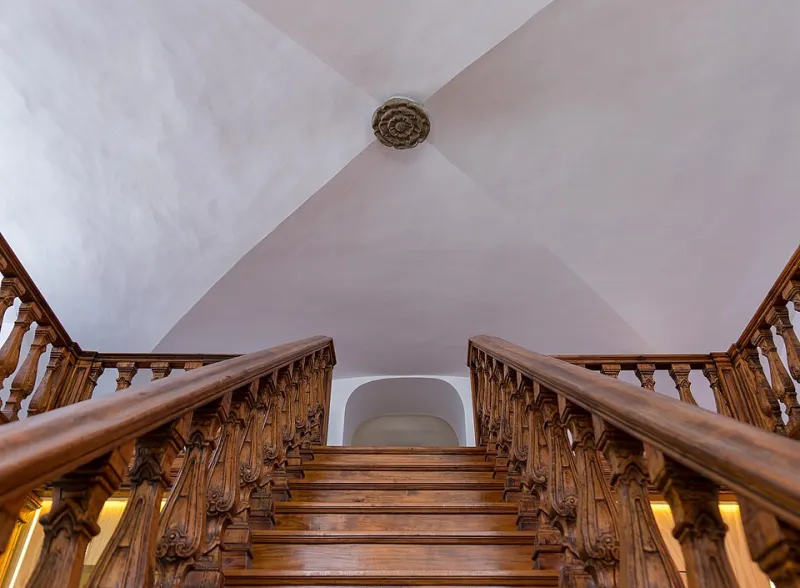
Photo: Jules Verne Times Two, CC BY-SA 4.0, via Wikimedia Commons
A staircase in a lane house is not just a way of getting upstairs. It is the piece of joinery you touch more than any other: hand on the rail, foot on the tread, every day, in the dark, in a hurry, carrying a laundry basket. It is also the element most often ripped out when a renovation begins, usually because it creaks, because the treads are dished, or because someone has decided a new oak number with glass balustrades would look 'cleaner'. Sometimes that is the right call. More often, the old stair has another fifty years in it and simply needs a patient afternoon or two.
The trick is to treat repair as an act of listening rather than restoration. You are not trying to make it look new. You are trying to make it safe, quiet and legible, so that its age reads as character rather than neglect.
First, Listen Before You Lift a Board
Walk the stair at different times of day. A creak that appears in the morning and vanishes by lunch is usually timber moving with humidity, not a structural failure. Note exactly where your foot lands when the noise happens, and whether it comes from the tread, the riser or the side string. Then look underneath with a torch. Old stairs are often open at the back of a cupboard or visible from a downstairs room, and a few minutes spent lying on your back will tell you more than any amount of prodding from above.
Check for three things: movement in the tread, splits running with the grain, and wobble in the handrail. A tread that flexes underfoot is not necessarily rotten, but it needs attention. A handrail that shifts when you lean on it is a safety issue, not a cosmetic one. And if the stair has been painted many times over, especially before the 1960s, assume there may be lead in the older layers. A home test kit is cheap; sanding without one is not.
The Anatomy of a Creak
Most creaks come from movement between two pieces of wood that were once tight. The wedge that holds a tread into its riser shrinks. The tread rubs against the string. A riser board has worked loose from its housing. The fix is rarely dramatic. Talcum powder worked into a joint can silence a friction creak for months. A thin wooden wedge and a little wood glue can take up movement without forcing anything. Where a tread has lifted slightly, a screw driven from underneath, up into the tread but not through the top surface, will pull it back down. Do not reach for expanding foam. Do not over-tighten. Old stairs are meant to have a little give; you are removing the rattle, not the breath.
If the creak is accompanied by a visible gap at the nosing, or a tread that dips noticeably, stop and look more closely. That is less about noise and more about wear.
Worn Treads: Repair Over Replace
A century of boots will hollow a softwood tread, especially at the nosing. The instinct is to replace the whole staircase, but treads can often be repaired in place. A good carpenter can cut out the worn section and let in a matching piece of pine, sometimes reclaimed, sometimes new but aged to blend. The patch will never be invisible, and that is fine. It reads as a repair, which is honest. If a tread is too far gone, replacing just that tread is still cheaper and less disruptive than a whole new stair, and it lets you keep the balusters, handrail and newel post that give the staircase its particular accent.
Avoid the temptation to sand every tread back to bare wood and varnish it to a shine. That removes the patina that took decades to accumulate and leaves a surface that shows every scratch. A gentle clean with a damp cloth and a little mild soap, followed by a coat of wax or a thin oil, will keep the timber fed without erasing its history. If the treads are painted, repaint rather than strip. A worn painted tread with a soft sheen is a far more forgiving surface than bare wood, and it suits a lane house better than a showroom finish.
Balusters, Handrails and the Safety Question
Loose balusters are common and easy to overlook until someone leans on the wrong one. Check each one by hand. A wobble at the base usually means the joint has opened; a wobble at the top can mean the handrail has worked loose from its brackets. Tighten what can be tightened, and replace only the balusters that are split or badly damaged. A joiner can match the profile, and a slightly different shade of paint will soon settle in.
Handrail height and the gap between balusters matter more than period correctness. If the stair is the main route upstairs for children or older visitors, a rail that feels solid and a gap you cannot get a head through are the priorities. Building regulations apply if you are altering the geometry of the stair, but for straightforward repair you are usually just making good what is already there.
Paint Layers as a Colour Clue
Old staircases are often a record of every scheme the house has known. A riser in faded ochre, a string in deep green, a handrail worn pale at the touch point: these are not accidents. They are useful evidence when you are choosing colours for the hall, the landing or the rooms beyond. A staircase is a colour sample you walk through every day.
If you are repainting, linseed paint suits old timber well because it moves with the wood and does not trap moisture. It also wears in rather than out, which is the right temperament for a stair. And if you are stripping paint, do it selectively. The worn edge of a handrail, dark from hands, is worth keeping. So is a patch of old colour under the lip of a tread. They are the stair's memory, and they cost nothing to leave alone.
When Replacement Is the Honest Answer
There are times when repair is not sensible: a string that has rotted through, significant movement in the supporting structure, a stair that is genuinely unsafe and cannot be made safe without rebuilding. Even then, salvage what you can. The handrail, the newel post and the best of the balusters can often be reused, which keeps something of the original stair in the new one. That is not sentimentality; it is good joinery and good sense.
Most old stairs, though, do not need replacing. They need a few hours of attention, a little wax, a tightened bracket and someone willing to listen to what the creaks are saying. Do that, and the stair will keep doing what it has always done: carrying the life of the house, one tread at a time.